The Evidence of Josephus
How would you say "cosmopolitan" 1500 years before the word was conceptualised?
The bringing together of kosmos and polis hadn't occurred in mankind's vocabulary. Describing something without the right words is difficult - nigh on impossible.
Cosmopolitan - kosmos polis, or is that polis kosmos?
"having an exciting and glamorous character associated with travel and a mixture of cultures."
Did Josephus string the following together to mean that sort of thing regarding the much lavished-upon Antonia?
"having all conveniences that cities wanted, it might seem to be composed of several cities, but by its magnificence it seemed a palace."
Perhaps you'd take that literally and use it as your only indesputable evidence that the temple mount was once the Antonia?
Well, go ahead! Because this page stacks up the evidence against it - how? To borrow a line from Matthew 24:15 "whoso readeth, let him understand."
Josephus' Sources
Josephus was an eye witness only while he lived (obvious?), so the earlier history he wrote would be gathered from one or more sources. Some may be from the works of earlier historians, and some might be through just talking to older people.
In fact, Josephus makes mention of those historians by name in "Against Apion" (book 2): "This is attested by many worthy writers; Polybius of Megalopolis, Strabo of Cappadocia, Nicolaus of Damascus, Timagenes, Castor the chronotoger, and Apollodorus;" (section 2).
Polybius was around during the Hellenistic period, and Strabo, born in 63 BC, witnessed that Roman period. Sadly, all we have of their's today is fragments.
Josephus' Evidence: Maccabean Era Part 1
In Wars book 1, Josephus kicks off around the time after Alexander the Great and the competing Greek factions - the Seleucids in particular. The following extracts from the books of the Wars relate to Jerusalem and the second temple period.
"Antiochus, who was called Epiphanes ... spoiled the temple, and put a stop to the constant practice of offering a daily sacrifice of expiation for three years and six months." (W1.1.1)
The Maccabeans of the Asamonean (Hasmonean) dynasty then follow.
"Now Judas... made an assault upon the garrison that was in the city, for it had not been cut off hitherto; so he ejected them out of the upper city, and drove the soldiers into the lower, which part of the city was called the Citadel. He then got the temple under his power, and cleansed the whole place, and walled it round about, and made new vessels for sacred ministrations, and brought them into the temple, because the former vessels had been profaned." (W1.1.4)
WARNING: We're going to get very confused because of the word "Citadel." The dictionary definition is; "a fortress, typically one on high ground above a city."
So here we have a group of troops stationed in the upper city being driven into the lower city, and to the part of the lower city having a fortress (i.e. castle) on high ground above that lower city.
The reason being that the Seleucids had turned the lower city into a fortified town in which they had planted the heathen. This Citadel had been built by the Seleucids to overlook the temple mount to make sure Antiochus Epiphanes rules were not being broken.
"However, Simon... got the garrison under, and demolished the citadel." (W1.2.2)
Simon Thassi, brother of Judas Maccabees, had driven out the Seleucid soldiers, and according to 1 Maccabees, had firstly taken up residence in this Citadel.
Now that's a contradiction of events; how could he live in the Citadel that he'd demolished?
We learn later from Josephus that Simon Thassi's son, John Hyrcanus - the Hasmonean Jewish high priest - had a Citadel (castle) built to the north of the temple mount to be able to guard it.
So was it the case that John Hyrcanus had built the north side Citadel for his father to live in?
Returning to (W1.1.4), "...Judas... then got the temple under his power, and cleansed the whole place, and walled it round about..." This seems to have been a joint effort between Judas Maccabees and his brother Simon Thassi. Can we unpack it in simple terms? Here I will try.
1. Both the city of David and the temple had been made heathen by Antiochus Epiphanes, who'd had this Seleucid castle built between the pre-Herodian temple mount and the city of David, enabling Antiochus Epiphanes' troops to overlook the proceedings at the temple.
2. Antiochus Epiphanes had also stationed his troops in the upper city, but then Simon drove Antiochus Epiphanes' soldiers out of the upper city into the Seleucid castle between the temple and the city of David.
3. Between them, combining (W1.1.4) and (W1.2.2), they overcame Antiochus Epiphanes' soldiers; drove them out; Simon demolished the Seleucid castle and Judas walled the temple "round about."
4. Judas possibly built over the demolished Seleucid castle an extension to the southern angle of the temple mount. Archaeologists reckon there is an indication of an Hasmonean extension to the south east corner.
5. Simon's son, John Hyrcanus, built a castle on the north side of the temple mount, and Simon lived there.
This might not be the most exacting picture but it neatly wraps it up.
Josephus' Evidence: Maccabean Era Part 2
John Hyrcanus left instructions for the country to be left in his wife's hands on his death. However, his son, Aristobulus decided he wanted to be king (the first king of the Hasmoneans), and starved his mother to death. Aristobulus later killed his brother Antigonus, and then Aristobulus became very ill (served him right?)
"Now Aristobulus... lay sick in a place called formerly the Citadel, though afterwards its name was changed to Antonia;" (W1.3.3)
So here we have the evidence that the Antonia was a Citadel (castle) and it was built by the Jewish high priest John Hyrcanus (at that time it wasn't Roman!).
Josephus' Evidence: Roman Era
At the time of this next extract from Josephus, we have a siblings quarrel between Hyrcanus II and Aristobulus II (John Hyrcanus' grand children) who both want to be king of the Hasmonean dynasty.
From this point on, Hyrcanus and Aristobulus refers to Hyrcanus II and Aristobulus II.
"upon Hyrcanus's complaint to his mother, she compassionated his case, and put Aristobulus's wife and sons under restraint in Antonia, which was a fortress that joined to the north part of the temple. It was, as I have already said, of old called the Citadel; but afterwards got the name of Antonia, when Antony was [lord of the East], just as the other cities, Sebaste and Agrippias, had their names changed" (W1.5.4)
And...
"the greatest part deserted Hyrcanus, and went over to Aristobulus; but Hyrcanus, with those of his party who staid with him, fled to Antonia," (W1.6.1)
Fast forwarding, and introducing Pompey the great of Rome, supporting the Hyrcanus side...
"At this treatment Pompey was very angry, and took Aristobulus into custody. And when he was come to the city, he looked about where he might make his attack; for he saw the walls were so firm, that it would be hard to overcome them; and that the valley before the walls was terrible; and that the temple, which was within that valley, was itself encompassed with a very strong wall, insomuch that if the city were taken, that temple would be a second place of refuge for the enemy to retire to." (W1.7.1)
Then ...
"So Aristobulus's party was worsted, and retired into the temple, and cut off the communication between the temple and the city, by breaking down the bridge that joined them together" (W1.7.2)
As I mentioned earlier and gave the reason for it, the city moved from the lower city to the upper city. The bridge joining the temple with the (upper) city was broken down, so this places the pre-Herodian (second) temple, east of the upper city - the bridge spanning the central valley between them could have been the early version of what Captain Wilson of the Palestine Exploration Fund found and named "Wilson's Arch".
As for how "the temple, which was within that valley" (W1.7.1) could have been pictured as being in the cental valley, it could have looked that way due to the upper city on the west hill rising over a hundred feet higher in altitude.
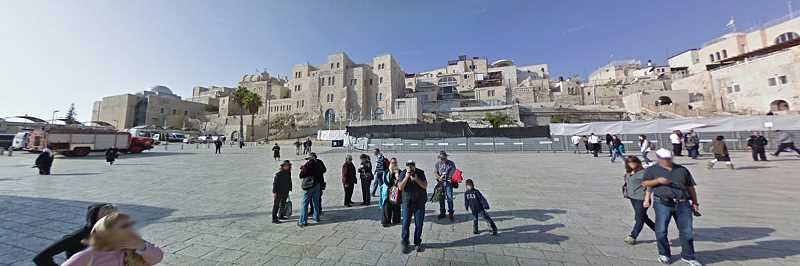
The height of the upper city above the west wall plaza, itself being much higher than in that day.
"But Pompey himself filled up the ditch that was on the north side of the temple, and the entire valley also, the army itself being obliged to carry the materials for that purpose. And indeed it was a hard thing to fill up that valley, by reason of its immense depth," (W1.7.3)
Let's see what Strabo, who was nearer this time, wrote:
"Pompey went over and overthrew them and rased their fortifications, and in particular took Jerusalem itself by force; for it was a rocky and well-walled fortress; and though well supplied with water inside, its outside territory was wholly without water; and it had a trench cut in rock, sixty feet in depth and two hundred and sixty feet in breadth; and, from the stone that had been hewn out, the wall of the temple was fenced with towers." (Strabo, Geography 16.40)
But can we place this ditch? We can eliminate the recently found 3000 year old "moat" (see Josephus' Missing Valley on the Miscellany page), as that was filled in during the Hasmonean era:
"... in those times when the Asamoneans reigned, they filled up that valley with earth, and had a mind to join the city to the temple." (W5.4.1)
On PEF plate 2 just above and just below the site of the Antonia as placed by Captain Warren, there are two excavated ditches. There's another one much further north outside the city walls, therefore, we can understand they cut ditches; trenches; fake valleys; dry moats to join natural valleys together for defensive purposes.
I'm not going to hazard a guess as to which side of the Antonia this trench was, only to say the section shown in PEF plate 37 immediately north of what is labelled "Barracks (formerly the Antonia)." This excavated ditch measures between 50 and 70 feet in depth, so 60 on average. And the Antonia joined to the north part of the temple, so, either way, the ditch was on the north side of the temple.
But, "... the entire valley also?" The central valley is still there. The Kedron valley is still there. It could be the Bethesda valley which branches off the Kedron valley where the pool of Bethesda is now.
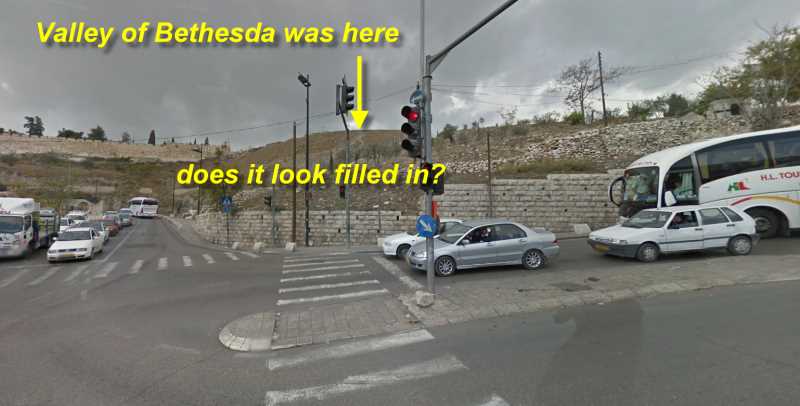
Josephus' Evidence: The Herodian Era
"ACCORDINGLY, in the fifteenth year of his reign, Herod rebuilt the temple, and encompassed a piece of land about it with a wall, which land was twice as large as that before enclosed." (Wars 1.21.1)
Now, I'd like to prove it was twice the size, so if we knew the size of the first temple mount, I can measure the temple mount of today and by simple math, see if it's twice as large, and that's more evidence that the temple mount is the temple mount.
Straight away we run into a difficulty. It's called the furlong. This is a translation error because there was no furlong in ancient Israel. The furlong was a construct of the early Anglo-Saxon times, it originally referred to the length of the furrow in one acre of a ploughed open field. So Josephus could not have measured in furlongs.
The correct unit is σταδίωυ which means stadia (plural of stadion), which might be likened to a furlong, but there is no exact modern-day equivalent to a stadion. However, we can work it backwards.
The compass of the Herodian temple mount is given as six furlongs: "while the entire compass of it was by measure six furlongs, including the tower of Antonia;" (Wars 5.5.2)
The measure I made using Google maps is about 5,150 feet with an area of roughly 1,660,000 sq ft.
That would make the stadion be 858 feet. Big feet!
Josephus says regarding Solomon's temple mount "This hill was walled all round, and in compass four furlongs, [the distance of] each angle containing in length a furlong:" (Antiquities 15.11.3 - words in braces from Whiston!)
So, based on the 858 feet stadion, that would make the area 736,164 sq ft. So not exactly times two (1,660,000 / 736,164 = 2.25).
Was Josephus being sloppy with his description or did I miss something out? Yes, I missed out the Hasmonean extension (referred to earlier in this page), and that's because I have no idea how big that was. Therefore I think there's enough evidence to show that when "Herod rebuilt the temple" he "encompassed a piece of land about it with a wall, which land was twice as large as that before enclosed."
But where's my evidence that Solomons temple mount was 858 feet by 858 feet?
1. The east wall of the temple mount is the origin or reference point. Why? Because the stones are earlier than Herod and the Hasmoneans. Plus, this rather long description from Josephus makes it clear:
"NOW this temple, as I have already said, was built upon a strong hill. At first the plain at the top was hardly sufficient for the holy house and the altar, for the ground about it was very uneven, and like a precipice; but when king Solomon, who was the person that built the temple, had built a wall to it on its east side, there was then added one cloister founded on a bank cast up for it, and on the other parts the holy house stood naked. But in future ages the people added new banks, (12) and the hill became a larger plain. They then broke down the wall on the north side, and took in as much as sufficed afterward for the compass of the entire temple. And when they had built walls on three sides of the temple round about, from the bottom of the hill, and had performed a work that was greater than could be hoped for, (in which work long ages were spent by them, as well as all their sacred treasures were exhausted, which were still replenished by those tributes which were sent to God from the whole habitable earth,) they then encompassed their upper courts with cloisters, as well as they [afterward] did the lowest [court of the] temple." (Wars 5.5.1)
2. We know Solomon's temple mount was built four-square:
"...each angle containing in length a furlong:" (Antiquities 15.11.3)
3. And we know from various verses in the Bible that Zerubabbel built the second temple in the same place.
What we need is another reference point to relate these pieces of evidence to.
At this point I'm going to hand you over to a video which will explain things far better than I can.
And from this video you can see my calculations of a stadion are three feet out.
As for the Hasmonean extension I'm not so sure it amounted to much. As it can be seen from the image below, the arches of the Herodian temple mount extension start before the end of the Hasmonean extension illustrated in the video. However, by now that's academic as this page should have already provided sufficient evidence that what's called the temple mount today was the temple mount.
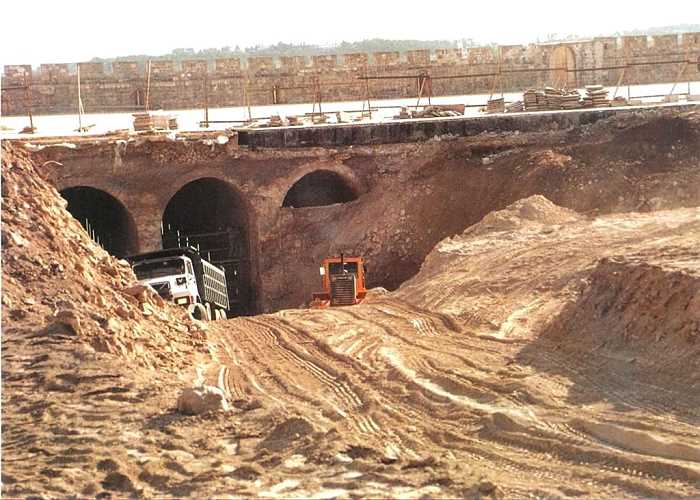
This image shows the arched supports of the Herodian southern extension, behind which (nearest the camera) is dirt infill
Back to (Wars 1.21.1), and we find;
"The cloisters he built from the foundation, but the citadel he repaired at a vast expense; nor was it other than a royal palace, which he called Antonia, in honor of Antony. He also built himself a palace in the Upper city, containing two very large and most beautiful apartments;"
From the Cambridge English dictionary - citadel: a strong castle in or near a city, where people can shelter from danger, especially during a war:
And so Herod repaired the Hasmonean built citadel, and named the result after Antony.
"nor was it other than" is the same as saying 'none other than...' "a royal palace."
Therefore, Herod, did a lavish 'fixer-upper' on the castle in honor of his friend Mark Antony.
Continuing with Josephus:
"[Florus]...thrust the multitude through the place called Bezetha, as they forced their way, in order to get in and seize upon the temple, and the tower Antonia. Florus also being desirous to get those places into his possession, brought such as were with him out of the king's palace, and would have compelled them to get as far as the citadel [Antonia;]" (W2.15.5)
Remember "He [king Herod] also built himself a palace in the Upper city," so this was the "king's palace" from which Florus was compelling the multitude to go through Bezetha in order to seize the temple.
That's a rather roundabout route to take if the temple was in the lower city - the original city of David. If they were going to seize the temple, the multitude could have done that far more efficiently by a more direct route from their position in the upper city - from the king's palace.
"they were afraid lest Florus should come again, and get possession of the temple, through Antonia; so they got immediately upon those cloisters of the temple that joined to Antonia, and cut them down. This cooled the avarice of Florus; for whereas he was eager to obtain the treasures of God [in the temple], and on that account was desirous of getting into Antonia, as soon as the cloisters were broken down, he left off his attempt; he then sent for the high priests and the sanhedrim, and told them that he was indeed himself going out of the city, but that he would leave them as large a garrison as they should desire." (W2.15.6)
So, if the temple mount was actually the Antonia, why this fixation with getting in through Bezetha?
If the temple mount was a Roman fortified city, having gates on all four sides, the easy route would be through the cheesemonger's (central/Tyropoean) valley.
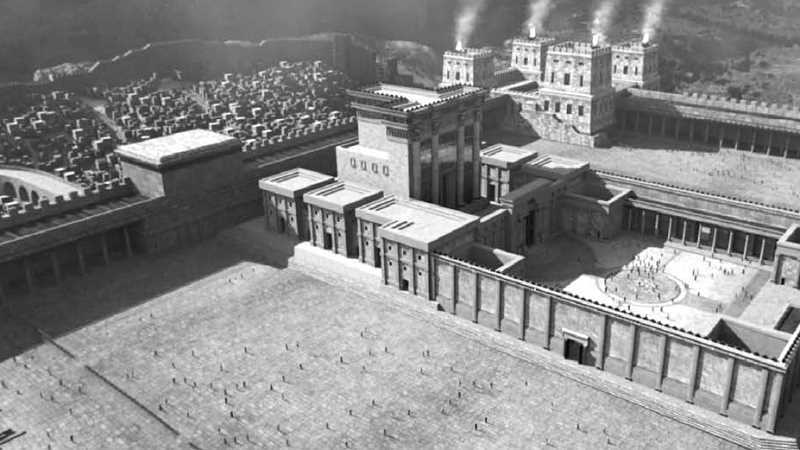
A close-enough artist's impression showing the bridge over the central valley to the left, and the Antonia to the northwest angle
And now for the cloisters: "they got immediately upon those cloisters of the temple that joined to Antonia, and cut them down."
The way from the castle into the temple must have been onto the tops of the cloisters which, you would imagine, had steps to the floor. If you cut them down there'd be a considerable drop. I suppose Florus could have gone and borrowed some ladders? Instead, by the looks of it, he just got upset and went away.
Next: king Agrippa (Herod II) gets involved by telling off the insurgent Jews...
"To which Agrippa replied, that what they had already done was like such as make war against the Romans; "for you have not paid the tribute which is due to Caesar and you have cut off the cloisters [of the temple] from joining to the tower Antonia. You will therefore prevent any occasion of revolt if you will but join these together again, and if you will but pay your tribute; for the citadel does not now belong to Florus, nor are you to pay the tribute money to Florus."" (W2.16.5)
"But on the next day, which was the fifteenth of the month Lous, [Ab,] they made an assault upon Antonia, and besieged the garrison which was in it two days, and then took the garrison, and slew them, and set the citadel on fire;" (W2.17.7)
(a garrison - not a legion)
This being the Jewish rebel's side assaulting the Antonia and slewing king Agrippa's troops.
Wars book's three and four offer little help in identifying locations, so now we jump to Wars book five where Josephus returns to describe Jerusalem, the temple, and the Antonia.
He picks up where he left off in Wars book 2, in Wars book 5, chapter 4, section 4:
"for these were not burnt by the Romans, but by these internal plotters, as we have already related, in the beginning of their rebellion. That fire began at the tower of Antonia, and went on to the palaces, and consumed the upper parts of the three towers themselves." (W5.4.4)
The latter part, due to the mention of the three towers, suggests the insurgents also set fire to Herod's palace, as it would be impossible for the flames to jump that far.
Josephus now further confirms the location of the temple:
"Now that wall began on the north, at the tower called "Hippicus," and extended as far as the "Xistus," a place so called, and then, joining to the council-house, ended at the west cloister of the temple. But if we go the other way westward, it began at the same place, and extended through a place called "Bethso," to the gate of the Essens; and after that it went southward, having its bending above the fountain Siloam, where it also bends again towards the east at Solomon's pool, and reaches as far as a certain place which they called "Ophlas," where it was joined to the eastern cloister of the temple." (W5.4.2)
This firmly places the temple as being on the temple mount. The wall going from what's known wrongly today as the tower of David (Herod's palace with the three towers to its north: Phasael, Hippicus and Mariamne) to the western cloister of the temple mount. The wall also going from the tower south to the pool of Siloam, then turning to the Ophel and via that to the eastern cloister.
He continues:
"The beginning of the third wall was at the tower Hippicus ... It was Agrippa who encompassed the parts added to the old city with this wall, which had been all naked before; for as the city grew more populous, it gradually crept beyond its old limits, and those parts of it that stood northward of the temple, and joined that hill to the city, made it considerably larger, and occasioned that hill, which is in number the fourth, and is called "Bezetha," to be inhabited also. It lies over against the tower Antonia, but is divided from it by a deep valley, which was dug on purpose, and that in order to hinder the foundations of the tower of Antonia from joining to this hill, and thereby affording an opportunity for getting to it with ease, and hindering the security that arose from its superior elevation; for which reason also that depth of the ditch made the elevation of the towers more remarkable. This new-built part of the city was called "Bezetha," in our language, which, if interpreted in the Grecian language, may be called "the New City."" (W5.4.2)
Note: "and those parts of it that stood northward of the temple ... called "Bezetha,""
Bezetha is on PEF plate 6. It stands north of the temple mount. Also note:
"It lies over against the tower Antonia, but is divided from it by a deep valley, which was dug on purpose, and that in order to hinder the foundations of the tower of Antonia from joining to this hill, and thereby affording an opportunity for getting to it with ease, and hindering the security that arose from its superior elevation; for which reason also that depth of the ditch made the elevation of the towers more remarkable." (W5.4.2)
It mentions the excavated ditch "which was dug on purpose" - remember Strabo mentioning it above?
A Legion?
"but on the corner where it joined to the two cloisters of the temple, it had passages down to them both, through which the guard (for there always lay in this tower a Roman legion) went several ways among the cloisters, with their arms, on the Jewish festivals, in order to watch the people, that they might not there attempt to make any innovations;" (W5.5.8)
There! Doesn't that prove how massive Antonia was, so it must have been the temple mount?
No it doesn't!
The above is from the Whiston translation, The Loeb Classical/Thackeray, and the Maynard translations don't say that.
The Greek word used is "τάγμα" which is "tagma." In Ancient Greek it was used for a body of soldiers. Strong's Concordance says "tagma: that which has been arranged in order, spec. a division, rank"
Thackeray says "a Roman cohort", and Maynard a "guard."
So there is absolutely no proof that several thousand Roman soldiers were ever in the tower of Antonia. They'd not fit either. The Antonia was a castle - not the temple mount.
The Two Colonnades
Supposedly two parallel 600 ft long colonnades linked the temple platform to the [redacted]'s temple, and I haven't been able to find any reference to these in any Josephus book.
It does say "The tower of Antonia lay at the angle where two porticoes, the western and the northern, of the first court of the temple met;"
I take that to mean the northwest corner of the temple mount, that being the first court or esplanade which carries the second court and the superstructure of the temple buildings.
"Nor was the superstructure unworthy of such foundations. The porticoes, all in double rows, were supported by columns five and twenty cubits high" (chapter 5, section 2)
I take this to mean that there were porticoes (cloisters) all round, and so these met at the north west corner - as they'd obviously meet at all corners - which is supported by...
"The porticoes were thirty cubits broad, and the complete circuit of them, embracing the tower of Antonia, measured six furlongs. The open court was from end to end variegated with paving of all manner of stones." (chapter 5, section 2)
The margin note in the Loeb translation states "The porticoes and the outer court."
Moving on to the margin note "The second court debarred to foreigners" we read "Proceeding across this towards the second court of the temple, one found it surrounded by a stone balustrade"
Nothing here suggests two parallel colonnades going from the imaginary Antonia to this imaginary temple.
Adding Words That Were Never There
The text of the Whiston translation says "Now as to the tower of Antonia, it was situated at the corner of two cloisters of the court of the temple..."
[redacted] adds his own words to alter the picture: "Now as to the tower of Antonia, it was situated [its entrance was] at the corner of two cloisters [colonnades] of the court of the temple..."
No translation adds [its entrance was] or [colonnades] - the Loeb reads "The tower of Antonia lay at the angle where two porticoes, the western and the northern, of the first court of the temple met"
Adding words of your own is deceit. Jesus said "Take heed that no man deceive you." This man is deceiving and I'm taking heed.
What They Don't Tell You
Let's face it, reading up things for yourself is a real bind. Most of us don't have the time, and when it comes to the ramblings of Josephus, spread over at least 27 books, where would you start?
The good news is that thanks to modern browser technology you can find things much quicker.
Under any browser's menu you'll see a function called "find" and that will find any word you type into it, for the document you have open in the browser.
Try it in book 5 of the Wars of the Jews on sacred-texts.com (that's the Whiston translation). Try the word "antonia."
You'll find the "new town" in the north-west, called Bezetha, lie over against the tower Antonia and it was divided from the same by a deep ditch. It's known by some as the waterless-moat (Strabo referenced it), otherwise it's called an excavated ditch. It joined the upper Tyropoean and Kedron valleys, and there's also one below the barracks, joining the same valleys, which might be the ditch dug by John (on the Jewish side) which he used as a fire-trap for the Romans. These are on PEF plate 2.
Interestingly, in the description of Jerusalem, Josephus tells of a wall which went down from the west side to the pool of Siloam, and then goes via the Ophel to the east cloisters of the temple. Now that's a bit of an awkward detail for all those who believe the story by [redacted].
And as for the tower of Antonia always having a Roman guard in it, read book 6 on how the Romans made an assault upon the tower of Antonia. That must have been a slip by Whiston - the other two translations don't say Roman. At the time it was a Jewish guard in the tower of Antonia. It may have been under Roman command at the time of Paul (Acts 21 & 22), but then again they could have been Agrippa's troops (c. 60 AD)
More Info In The Antiquities
In Book 15 of the Antiquities of The Jews, Chapter 11, section 4, Josephus tells us more about the Antiona.
"Now on the north side [of the temple] was built a citadel, whose walls were square, and strong, and of extraordinary firmness. This citadel was built by the kings of the Asamonean race, who were also high priests before Herod, and they called it the Tower, in which were reposited the vestments of the high priest, which the high priest only put on at the time when he was to offer sacrifice. These vestments king Herod kept in that place; and after his death they were under the power of the Romans, until the time of Tiberius Caesar;" (words in square brackets are from Whiston's translation - they are not mine)
[redacted] says the Antonia was built by or to plans by the Romans. Josephus disagrees here because he writes "This citadel was built by the kings of the Asamonean race, who were also high priests before Herod." In other places, Josephus writes it was built by John Hyrcanus, which agrees with "the kings of the Asamonean race."
As proof that this citadel became the Antonia, Josephus writes "But for the tower itself, when Herod the king of the Jews had fortified it more firmly than before, in order to secure and guard the temple, he gratified Antonius, who was his friend, and the Roman ruler, and then gave it the name of the Tower of Antonia."
Notice "Herod the king of the Jews" fortified it and renamed it Antonia. It was never Roman until the Romans took control of it. It was a Jewish built citadel.
Where was it? "on the north side [of the temple]"
It doesn't say 600 feet north of the temple, just on the north side.
Josephus describes the four gates to the west wall of the temple mount:
"Now in the western quarters of the enclosure of the temple there were four gates; the first led to the king's palace, and went to a passage over the intermediate valley; two more led to the suburbs of the city; and the last led to the other city, where the road descended down into the valley by a great number of steps,"
That's Wilson's gate, Wilson's arch, Barclay's gate, and Robinson's arch.
Yet still, against such a flood of information, people are happy to believe the temple mount was the tower of Antonia. Deceived or what?
If you don't read it for yourself, you will never know. But reading takes effort and a lot of time - it's hard work, and so is the Bible. When it comes to the Bible we are told "...every word that proceeds from the mouth of God," but it seems we don't put in that same effort to reading other works to prove all things. That's quite understandable - we are only human - but that's how we become so easily deceived.
The Real Antonia
I can empathize with those who feel the Antonia can't have been as tiny as it looks in that model village of Jerusalem, but there's no way the temple mount was the Antonia - Josephus as well as God's Bible makes that abundantly clear.
Perhaps it would help to think of Antonia as being a little larger? Maybe square rather than its distorted quadrilateral?
Josephus wrote "Now on the north side [of the temple] was built a citadel, whose walls were square, and strong"
Even if he meant square as in right-angle, it isn't right-angled now. And if he meant it was square, it isn't square now.
Perhaps the Antonia was a square, and extended further into the temple mount than exists today. What evidence could there be?
The 50 cubit rock
On PEF plate 37 you can see a section through the barracks* at the north-west angle of the temple mount. The rock beneath it is just short of 50 cubits as you can estimate for yourself from the scale.
(*the Turkish barracks as of late in the 19th century)
You can see it slopes away the same distance again into the area now considered the temple mount (the sanctuary) "The Rock Scarp in West Wall".
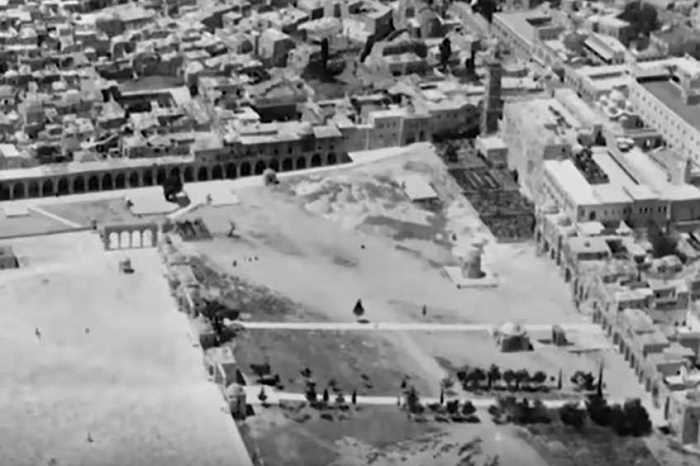
From the inside of the temple mount, the north-west corner is uphill to the gardens where a few feet of the rock can be seen - not the full 50 cubits - far from it.
Some archaeologists claim the square hole in the wall above this piece of rock indicates where the wooden joists of the cloisters terminated, but that would mean the cloisters of the north-west angle were uphill, and I don't think Herod would have tolerated that.
So it's quite possible that the tower of Antonia was, as Josephus wrote "Now on the north side [of the temple] was built a citadel, whose walls were square, and strong"
Nothing, it seems, is left of the Antonia unless the rock on which it was built is included.
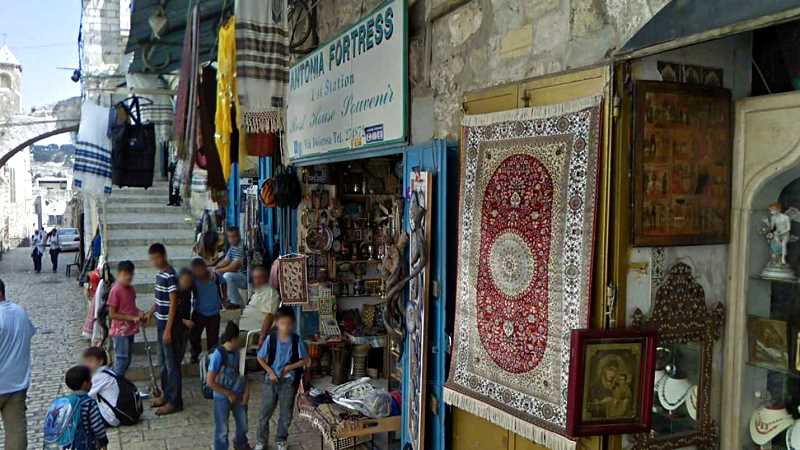
The rock face can be seen in the back of one of the shops on Lion's gate, and the shop next door to the left of it is called Antonia Fortress. Today the building above it isn't 40 cubits, so a lot was thrown down back in the day.
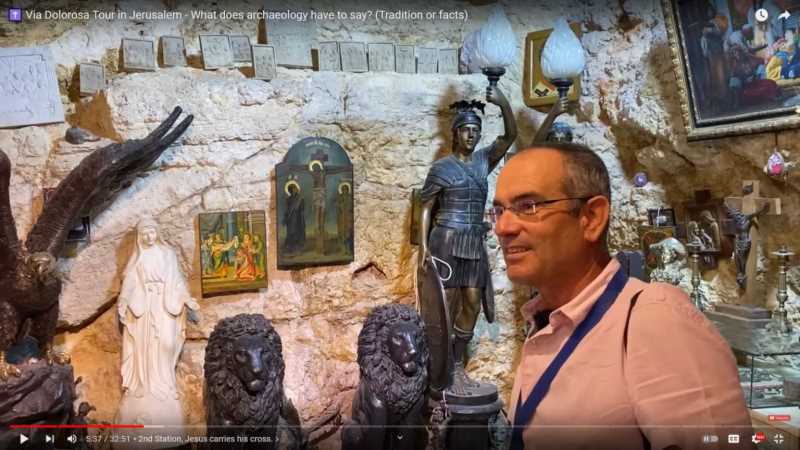
A still from a Danny the Digger Youtube video showing the rock face back wall of the gift shop (above), and the shop next door (below)
The Foursquare Temple
I don't want to sound facetious but the temple mount isn't right-angle square. From ground level or over on the surrounding hills, the trapeziodal error we can see today due to air travel, might not have been so noticeable. The excuse given is that Herod had to accept the compromised shape or it would have crossed the central valley.
What Josephus wrote in Wars 6.5.4 may have led some to believe that the Antonia extended into the temple mount, and I guess that's a possibility given the description:
"Now as to the tower of Antonia, it was situated at the corner of two cloisters of the court of the temple; of that on the west, and that on the north;" (Wars 5.5.8)
If the Antonia impinged into the northwest corner of the temple mount, then that description would still apply. The cloisters of the north and west would terminate at the south and east walls of the Antonia.
But is there any evidence they did?
"Now if any one consider these things, he will find that God takes care of mankind, and by all ways possible foreshows to our race what is for their preservation; but that men perish by those miseries which they madly and voluntarily bring upon themselves; for the Jews, by demolishing the tower of Antonia, had made their temple four-square, while at the same time they had it written in their sacred oracles, "That then should their city be taken, as well as their holy house, when once their temple should become four-square." (Wars 6.5.4)
Maybe that's evidence, or perhaps we take it with a pinch of salt?
back to top