Temple Location Evidence in the Bible
Old Testament
Remember in the Bible where Abraham told Isaac, God will see to it? (Jehovahjireh - see Genesis 22)
Well, regarding the location of the temple, God saw to it in duplicate:
1 Kings 8:1
"Then Solomon assembled the elders of Israel, and all the heads of the tribes, the chief of the fathers of the children of Israel, unto king Solomon in Jerusalem, that they might bring up the ark of the covenant of the LORD out of the city of David, which is Zion."
2 Chronicles 5:2
"Then Solomon assembled the elders of Israel, and all the heads of the tribes, the chief of the fathers of the children of Israel, unto Jerusalem, to bring up the ark of the covenant of the LORD out of the city of David, which is Zion."
So, if you can place the city of David, look for somewhere that's up, as well as being out of — the city of David (which was, incidentally, Zion; the Jebusite fortress, which the Bible tells you about...).
To the west it's down into the Tyropoean valley; to the east it's down to the Kedron valley; and to the south it's down to where these two valleys meet.
The only option of up, is to the north in a north-westerly direction. Guess what's there today? Yes, the temple mount!
But what if we squeezed the city of David smaller and pushed it as far as south as we could, then we can place the temple south of the temple mount, and claim the fame?
Well, that's a bit awkward. And that's because of a thing called the Millo, and also the Ophel tower - not forgetting David's house, Solomon's palace, and Pharaoh's daughter's house. These kind of get in the way of the imagined temple courtyard pictured below.
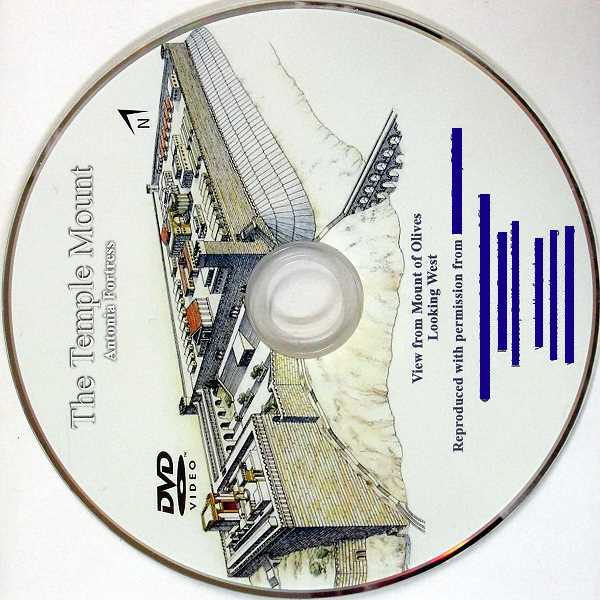
Photo of a DVD sent to me which tells a different story of the temple location, and in my opinion a fake location.
If we can prove the Millo and the Ophel existed in the locations archaeologists reckon they've found them, then it's game over for the temple mount deniers.
As is so often, we can't find a neat one-liner to cherry-pick, but if we can give the scriptures sufficient time to read and digest, we can get a mental picture. So let's take a look back to the beginnings of the city of David:
2 Samuel 5: 6-11
"And the king and his men went to Jerusalem unto the Jebusites, the inhabitants of the land: which spake unto David, saying, Except thou take away the blind and the lame, thou shalt not come in hither: thinking, David cannot come in hither.
Nevertheless David took the strong hold of Zion: the same is the city of David.
And David said on that day, Whosoever getteth up to the gutter, and smiteth the Jebusites, and the lame and the blind that are hated of David's soul, he shall be chief and captain. Wherefore they said, The blind and the lame shall not come into the house.
So David dwelt in the fort, and called it the city of David. And David built round about from Millo and inward.
STOP PRESS! Why would king David build from Millo and inward? Because above Millo there was a rock cut trench archaeologists only just discovered - July 2024 - so he'd have to build inward!
And David went on, and grew great, and the LORD God of hosts was with him.
And Hiram king of Tyre sent messengers to David, and cedar trees, and carpenters, and masons: and they built David an house."
The Millo means an infil, and in some Bibles it says "the supporting terraces," and archaeologists have found these just about where the imagined (AKA fake) temple is supposed to have been.
Also note the word "gutter" and "Whosoever getteth up to the gutter, and smiteth the Jebusites." This gutter is an underground roadway from inside the "strong hold of Zion" down to the Gihon spring, and the spring was also fortified. This was to ensure there was no way into the Jebusite fort - not even to collect water. The Jebusites were so confident that nobody could get in, that they taunted David by saying that even the blind and the lame could defend the fort.
The gutter, underground roadway, or tunnel (call it what you will), was discovered by Charles Warren of the Palestine Exploration Fund in 1867-1870, and that places the Jebusite fort where it's pictured in the image below.
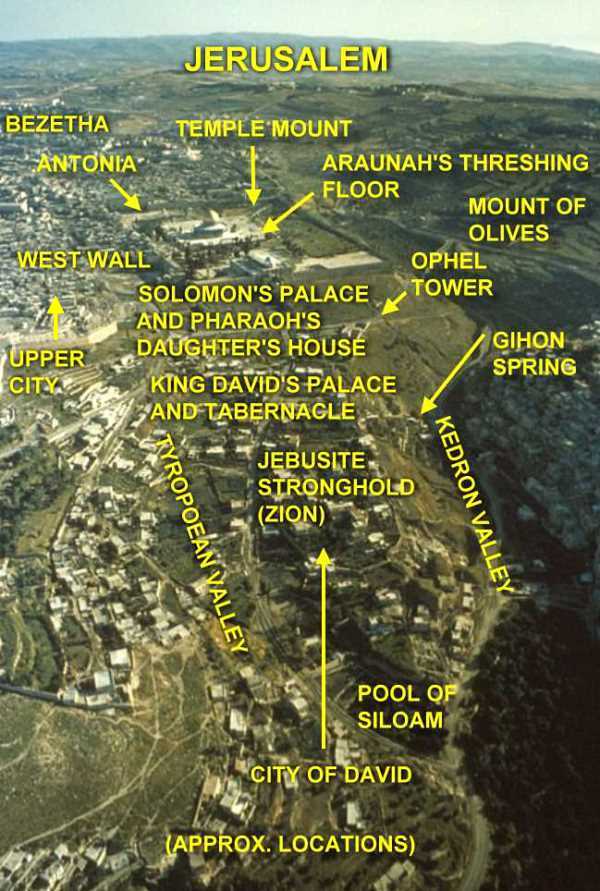
This video also helps place locations:
But if the spring itself was fortified, how would anybody get in? There was (and still is) an upper watercourse (2 Chronicles 32:30 proves it!) probably used to irrigate Jebusite crops in the Kedron valley.
God provides parallel verses to what we read in 2 Samuel 5: 6-11 in 1 Chronicles 11:4-8
"And David and all Israel went to Jerusalem, which is Jebus; where the Jebusites were, the inhabitants of the land.
And the inhabitants of Jebus said to David, Thou shalt not come hither. Nevertheless David took the castle of Zion, which is the city of David.
And David said, Whosoever smiteth the Jebusites first shall be chief and captain. So Joab the son of Zeruiah went first up, and was chief.
And David dwelt in the castle; therefore they called it the city of David.
And he built the city round about, even from Millo round about: and Joab repaired the rest of the city."
It clearly states that David built the city round about the castle and the Millo or supporting terraces, which are above the Kedron valley.
Next we reach 2 Samuel 6:12-17...
"And it was told king David, saying, The LORD hath blessed the house of Obededom, and all that pertaineth unto him, because of the ark of God. So David went and brought up the ark of God from the house of Obededom into the city of David with gladness.
And it was so, that when they that bare the ark of the LORD had gone six paces, he sacrificed oxen and fatlings.
And David danced before the LORD with all his might; and David was girded with a linen ephod.
So David and all the house of Israel brought up the ark of the LORD with shouting, and with the sound of the trumpet.
And as the ark of the LORD came into the city of David, Michal Saul's daughter looked through a window, and saw king David leaping and dancing before the LORD; and she despised him in her heart.
And they brought in the ark of the LORD, and set it in his place, in the midst of the tabernacle that David had pitched for it: and David offered burnt offerings and peace offerings before the LORD."
And 1 Chronicles 15: 1-3,25-29...
"And David made him houses in the city of David, and prepared a place for the ark of God, and pitched for it a tent.
Then David said, None ought to carry the ark of God but the Levites: for them hath the LORD chosen to carry the ark of God, and to minister unto him for ever.
And David gathered all Israel together to Jerusalem, to bring up the ark of the LORD unto his place, which he had prepared for it.
So David, and the elders of Israel, and the captains over thousands, went to bring up the ark of the covenant of the LORD out of the house of Obededom with joy.
And it came to pass, when God helped the Levites that bare the ark of the covenant of the LORD, that they offered seven bullocks and seven rams.
And David was clothed with a robe of fine linen, and all the Levites that bare the ark, and the singers, and Chenaniah the master of the song with the singers: David also had upon him an ephod of linen.
Thus all Israel brought up the ark of the covenant of the LORD with shouting, and with sound of the cornet, and with trumpets, and with cymbals, making a noise with psalteries and harps.
And it came to pass, as the ark of the covenant of the LORD came to the city of David, that Michal, the daughter of Saul looking out at a window saw king David dancing and playing: and she despised him in her heart."
So, by this time David had a house, and being the king would most likely have it looking down on his city (so to the north), but then again some may want to be argumentative. Wherever it was, David placed the tabernacle of God near him, and brought "up the ark of the LORD unto his place, which he had prepared for it."
Then, in 2 Samuel 24:18-25...
"And Gad came that day to David, and said unto him, Go up, rear an altar unto the LORD in the threshingfloor of Araunah the Jebusite.
And David, according to the saying of Gad, went up as the LORD commanded.
And Araunah looked, and saw the king and his servants coming on toward him: and Araunah went out, and bowed himself before the king on his face upon the ground.
And Araunah said, Wherefore is my lord the king come to his servant? And David said, To buy the threshingfloor of thee, to build an altar unto the LORD, that the plague may be stayed from the people.
And Araunah said unto David, Let my lord the king take and offer up what seemeth good unto him: behold, here be oxen for burnt sacrifice, and threshing instruments and other instruments of the oxen for wood.
All these things did Araunah, as a king, give unto the king. And Araunah said unto the king, The LORD thy God accept thee.
And the king said unto Araunah, Nay; but I will surely buy it of thee at a price: neither will I offer burnt offerings unto the LORD my God of that which doth cost me nothing. So David bought the threshingfloor and the oxen for fifty shekels of silver.
And David built there an altar unto the LORD, and offered burnt offerings and peace offerings. So the LORD was intreated for the land, and the plague was stayed from Israel."
So, Gad told David to "Go up", and from the lay of the land, up meant north of David's house and the tabernacle (tent), and so would be somewhere between Ophel and the hill's peak - which is somewhere under today's temple mount. A threshing floor was usually located on top of a hill for the wind to separate the dusty chaff from the grain.
Again, we have it in duplicate in 1 Chronicles 21:18-28...
"Then the angel of the LORD commanded Gad to say to David, that David should go up, and set up an altar unto the LORD in the threshingfloor of Ornan the Jebusite.
And David went up at the saying of Gad, which he spake in the name of the LORD.
And Ornan turned back, and saw the angel; and his four sons with him hid themselves. Now Ornan was threshing wheat.
And as David came to Ornan, Ornan looked and saw David, and went out of the threshingfloor, and bowed himself to David with his face to the ground.
Then David said to Ornan, Grant me the place of this threshingfloor, that I may build an altar therein unto the LORD: thou shalt grant it me for the full price: that the plague may be stayed from the people.
And Ornan said unto David, Take it to thee, and let my lord the king do that which is good in his eyes: lo, I give thee the oxen also for burnt offerings, and the threshing instruments for wood, and the wheat for the meat offering; I give it all.
And king David said to Ornan, Nay; but I will verily buy it for the full price: for I will not take that which is thine for the LORD, nor offer burnt offerings without cost.
So David gave to Ornan for the place six hundred shekels of gold by weight.
And David built there an altar unto the LORD, and offered burnt offerings and peace offerings, and called upon the LORD; and he answered him from heaven by fire upon the altar of burnt offering.
And the LORD commanded the angel; and he put up his sword again into the sheath thereof.
At that time when David saw that the LORD had answered him in the threshingfloor of Ornan the Jebusite, then he sacrificed there."
Note here that Ornan is Araunah (pronounced Aravnah) - they're one and the same and just like today, people have more than one given name.
So here we have the beginnings of the temple, up (that word again) from where David dwelt, unto a threshing floor. A threshing floor being in a lofty location to take advantage of the breeze required to separate the grain from the chaff. The flat surface of the threshing floor served the purpose as the base for a sacrificial altar.
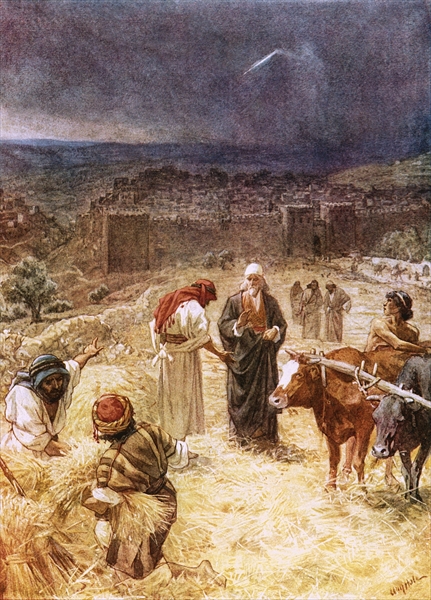
Mount Moriah looking south toward the city of David from Ornan's threshing floor
Some will argue that the rock under the dome isn't flat enough for a threshing floor, and that's because it wasn't the threshing floor! The altar of the jewish temple was not the holy of holies - it was outside of the temple building in the open air.
From now on I will not write out the duplicates (parallel verses), as it only serves to lengthen this evidence. I will quote the relevent places in the Bible, continuing in chronological order. The student with a Bible with margin notes will be able to check out parallel verses to show they are true.
So next, in 1 Chronicles 28:10-21...
"Take heed now; for the LORD hath chosen thee to build an house for the sanctuary: be strong, and do it.
Then David gave to Solomon his son the pattern of the porch, and of the houses thereof, and of the treasuries thereof, and of the upper chambers thereof, and of the inner parlours thereof, and of the place of the mercy seat,
And the pattern of all that he had by the spirit, of the courts of the house of the LORD, and of all the chambers round about, of the treasuries of the house of God, and of the treasuries of the dedicated things:
Also for the courses of the priests and the Levites, and for all the work of the service of the house of the LORD, and for all the vessels of service in the house of the LORD.
He gave of gold by weight for things of gold, for all instruments of all manner of service; silver also for all instruments of silver by weight, for all instruments of every kind of service:
Even the weight for the candlesticks of gold, and for their lamps of gold, by weight for every candlestick, and for the lamps thereof: and for the candlesticks of silver by weight, both for the candlestick, and also for the lamps thereof, according to the use of every candlestick.
And by weight he gave gold for the tables of shewbread, for every table; and likewise silver for the tables of silver:
Also pure gold for the fleshhooks, and the bowls, and the cups: and for the golden basons he gave gold by weight for every bason; and likewise silver by weight for every bason of silver:
And for the altar of incense refined gold by weight; and gold for the pattern of the chariot of the cherubims, that spread out their wings, and covered the ark of the covenant of the LORD.
All this, said David, the LORD made me understand in writing by his hand upon me, even all the works of this pattern.
And David said to Solomon his son, Be strong and of good courage, and do it: fear not, nor be dismayed: for the LORD God, even my God, will be with thee; he will not fail thee, nor forsake thee, until thou hast finished all the work for the service of the house of the LORD.
And, behold, the courses of the priests and the Levites, even they shall be with thee for all the service of the house of God: and there shall be with thee for all manner of workmanship every willing skilful man, for any manner of service: also the princes and all the people will be wholly at thy commandment."
(parallel in 1 Kings 6:1-10)
This clearly shows that Solomon was to build the temple to David's God-given plans. Also note the number of buildings the temple comprised of:
"Then David gave to Solomon his son the pattern of the porch, and of the houses thereof, and of the treasuries thereof, and of the upper chambers thereof, and of the inner parlours thereof, and of the place of the mercy seat,
And the pattern of all that he had by the spirit, of the courts of the house of the LORD, and of all the chambers round about, of the treasuries of the house of God, and of the treasuries of the dedicated things:"
The importance of noting this will become apparent when we reach the Olivet discourse. Admittedly the above is a description of the buildings of the first temple, and the second wasn't as lavish, but the Herodian expansion was much greater.
Continuing in 1 Chronicles 29:8 then19-22...
"O LORD God of Abraham, Isaac, and of Israel, our fathers, keep this for ever in the imagination of the thoughts of the heart of thy people, and prepare their heart unto thee:
And give unto Solomon my son a perfect heart, to keep thy commandments, thy testimonies, and thy statutes, and to do all these things, and to build the palace, for the which I have made provision.
And David said to all the congregation, Now bless the LORD your God. And all the congregation blessed the LORD God of their fathers, and bowed down their heads, and worshipped the LORD, and the king.
And they sacrificed sacrifices unto the LORD, and offered burnt offerings unto the LORD, on the morrow after that day, even a thousand bullocks, a thousand rams, and a thousand lambs, with their drink offerings, and sacrifices in abundance for all Israel:
And did eat and drink before the LORD on that day with great gladness. And they made Solomon the son of David king the second time, and anointed him unto the LORD to be the chief governor, and Zadok to be priest."
I doubt there'd have been enough room to sacrifice three thousand farm animals in the heavily populated city of David. That's another reason that I see it being up and out on the field of Araunah/Ornan, where David built the altar.
2 Chronicles 2:1-2 then 17-18
"And Solomon determined to build an house for the name of the LORD, and an house for his kingdom.
And Solomon told out threescore and ten thousand men to bear burdens, and fourscore thousand to hew in the mountain, and three thousand and six hundred to oversee them.
And Solomon numbered all the strangers that were in the land of Israel, after the numbering wherewith David his father had numbered them; and they were found an hundred and fifty thousand and three thousand and six hundred.
And he set threescore and ten thousand of them to be bearers of burdens, and fourscore thousand to be hewers in the mountain, and three thousand and six hundred overseers to set the people a work."
A workforce of 153,600 could never all fit themselves inside the city of David to work on a temple there. They must have been on the mount top field of Araunah's/Ornan's threshing floor.
2 Chronicles 3:1
"Then Solomon began to build the house of the LORD at Jerusalem in mount Moriah, where the Lord appeared unto David his father, in the place that David had prepared in the threshingfloor of Ornan the Jebusite."
That sums it up for me!
And that leads us right back to where we started at the top of this page...
2 Chronicles 5:2
"Then Solomon assembled the elders of Israel, and all the heads of the tribes, the chief of the fathers of the children of Israel, unto Jerusalem, to bring up the ark of the covenant of the LORD out of the city of David, which is Zion."
(parallel 1 Kings 8:1)
So this is the evidence provided by God. Do we believe Him?
Well, just in case, there's more!
2 Chronicles 8:1 and 11
"And it came to pass at the end of twenty years, wherein Solomon had built the house of the LORD, and his own house,
And Solomon brought up the daughter of Pharaoh out of the city of David unto the house that he had built for her: for he said, My wife shall not dwell in the house of David king of Israel, because the places are holy, whereunto the ark of the LORD hath come."
(note: the tabernacle next to king David's palace was where "the ark of the LORD hath come")
2 Chronicles 9:3-4
"And when the queen of Sheba had seen the wisdom of Solomon, and the house that he had built,
And the meat of his table, and the sitting of his servants, and the attendance of his ministers, and their apparel; his cupbearers also, and their apparel; and his ascent by which he went up into the house of the LORD; there was no more spirit in her."
(try also 1 Kings 9)
Now, after that came the end of Solomon's reign, and a procession of kings down through the ages.
By now, what we should be able to see in our mind's eye is, from north to south: the temple; Solomon's palace; Solomon's wife's house (the daughter of Pharaoh); king David's palace; then the whole of the city of David between the Tyropoean and Kedron valleys, right down to its southern tip where the valleys join.
But if that can't yet be grasped, I'll now labour the point...
2 Chronicles 27:1-3
"Jotham was twenty and five years old when he began to reign, and he reigned sixteen years in Jerusalem. His mother's name also was Jerushah, the daughter of Zadok.
And he did that which was right in the sight of the LORD, according to all that his father Uzziah did: howbeit he entered not into the temple of the LORD. And the people did yet corruptly.
He built the high gate of the house of the LORD, and on the wall of Ophel he built much."
Here we see the introduction of the Ophel tower and it's high gate, and PEF plate 40 will show you where it was.
Eventually we come to king Hezekiah...
2 Chronicles 29:20
"Then Hezekiah the king rose early, and gathered the rulers of the city, and went up to the house of the LORD."
2 Chronicles 32:2-5 then 30
"And when Hezekiah saw that Sennacherib was come, and that he was purposed to fight against Jerusalem,
He took counsel with his princes and his mighty men to stop the waters of the fountains which were without the city: and they did help him.
So there was gathered much people together, who stopped all the fountains, and the brook that ran through the midst of the land, saying, Why should the kings of Assyria come, and find much water?
Also he strengthened himself, and built up all the wall that was broken, and raised it up to the towers, and another wall without, and repaired Millo in the city of David, and made darts and shields in abundance.
This same Hezekiah also stopped the upper watercourse of Gihon, and brought it straight down to the west side of the city of David. And Hezekiah prospered in all his works."
2 Chronicles 33:13-14
"And prayed unto him: and he was intreated of him, and heard his supplication, and brought him again to Jerusalem into his kingdom. Then Manasseh knew that the LORD he was God.
Now after this he built a wall without the city of David, on the west side of Gihon, in the valley, even to the entering in at the fish gate, and compassed about Ophel, and raised it up a very great height, and put captains of war in all the fenced cities of Judah."
Now, I don't think I have much to add to the above, except that in the DVD we're told there was no other water than that of the Gihon spring, and that the water shaft (the underground roadway) was connected to the Gihon spring, and it was syphonic such that the water gushed up the water shaft, thus proving the temple was in the city of David.
This is simply untrue. God's words say "He took counsel with his princes and his mighty men to stop the waters of the fountains which were without the city: and they did help him. So there was gathered much people together, who stopped all the fountains, and the brook that ran through the midst of the land, saying, Why should the kings of Assyria come, and find much water?" (2 Chronicles 32:3-4 above)
Hezekiah then did another thing "This same Hezekiah also stopped the upper watercourse of Gihon, and brought it straight down to the west side of the city of David." (2 Chronicles 32:30 above)
Huh, puncture a syphon and the water doesn't gush. By digging a tunnel from the spring to the west of the city, that punctures the syphon!
Yes, but, it did say "Hezekiah also stopped the upper watercourse of Gihon," so that must have been the gusher? Actually no. The Canaanites had dug this "upper watercourse" to irrigate the fields in the Kedron valley long before this time.
"The Canaanite Tunnel is a name given to a tunnel running from the Gihon spring to the southern end of Biblical Jerusalem, ending at the Pool of Siloam. Unlike its parallel Hezekiah’s tunnel, this tunnel has several outlets along its course, suggesting it irrigated agricultural plots in the Kidron Valley. Being at a higher elevation than Hezekiah’s tunnel, it is assumed that it preceded it.
Most scholars argue it is from Canaanite times, parallel to the Middle Bronze Age."
So yes, there was an upper water course - God doesn't lie.
Sadly, at this place in the Bible, we come to the end of the first temple period. Jerusalem was invaded by the Babylonians...
2 Chronicles 36:19-21
"And they burnt the house of God, and brake down the wall of Jerusalem, and burnt all the palaces thereof with fire, and destroyed all the goodly vessels thereof.
And them that had escaped from the sword carried he away to Babylon; where they were servants to him and his sons until the reign of the kingdom of Persia:
To fulfil the word of the LORD by the mouth of Jeremiah, until the land had enjoyed her sabbaths: for as long as she lay desolate she kept sabbath, to fulfil threescore and ten years."
...and the inhabitants were led away captive to Babylon for 70 years.
But did they forget?
Psalm 137:5-6
"If I forget thee, O Jerusalem, let my right hand forget her cunning.
If I do not remember thee, let my tongue cleave to the roof of my mouth; if I prefer not Jerusalem above my chief joy."
It would be easy to dismiss that anybody had memories of where Solomon's temple had been after 70 years of captivity, but Psalm 137 makes it clear that forgetting wasn't an option. Memories are passed down from parents to children, from aunts and uncles and from elders to youths. That is what Psalm 137:5-6 is about.
It's conceivable there were other populations other than Jews, and it's hard to believe they'd keep schtum. And even if they did, and no memories were passed down, Cyrus king of Persia knew!
2 Chronicles 36:22-23
"Now in the first year of Cyrus king of Persia, that the word of the LORD spoken by the mouth of Jeremiah might be accomplished, the LORD stirred up the spirit of Cyrus king of Persia, that he made a proclamation throughout all his kingdom, and put it also in writing, saying,
Thus saith Cyrus king of Persia, All the kingdoms of the earth hath the LORD God of heaven given me; and he hath charged me to build him an house in Jerusalem, which is in Judah. Who is there among you of all his people? The LORD his God be with him, and let him go up."
But did they build it at the same location?
Ezra 3:10-12
"And when the builders laid the foundation of the temple of the LORD, they set the priests in their apparel with trumpets, and the Levites the sons of Asaph with cymbals, to praise the LORD, after the ordinance of David king of Israel.
And they sang together by course in praising and giving thanks unto the LORD; because he is good, for his mercy endureth for ever toward Israel. And all the people shouted with a great shout, when they praised the LORD, because the foundation of the house of the LORD was laid.
But many of the priests and Levites and chief of the fathers, who were ancient men, that had seen the first house, when the foundation of this house was laid before their eyes, wept with a loud voice; and many shouted aloud for joy:"
Let's repeat that last bit because it is important to God's evidence...
"But many of the priests and Levites and chief of the fathers, who were ancient men, that had seen the first house, when the foundation of this house was laid before their eyes, wept with a loud voice; and many shouted aloud for joy:"
Therefore, the second temple under the command of Zerubbabel was built on the same foundation - at the same place.
The DVD image pictures a courtyard between the temple mount as we know it, and the imaginary temple mount as [redacted] and his colleagues see it. This rides roughshod over the evidence that there were other buildings in that vicinity.
Nehemiah 3:15,26-27
"But the gate of the fountain repaired Shallun the son of Colhozeh, the ruler of part of Mizpah; he built it, and covered it, and set up the doors thereof, the locks thereof, and the bars thereof, and the wall of the pool of Siloah by the king's garden, and unto the stairs that go down from the city of David.
Moreover the Nethinims dwelt in Ophel, unto the place over against the water gate toward the east, and the tower that lieth out.
After them the Tekoites repaired another piece, over against the great tower that lieth out, even unto the wall of Ophel."
Who was Nehemiah?
"Nehemiah was a Jewish leader who supervised the rebuilding of Jerusalem in the mid-5th century bce after his release from captivity by the Persian king Artaxerxes I." (Britannica)
Nehemiah gives a good description of where things were, including the Ophel and the Ophel tower "that lieth out."
The "Nethinims [temple assistants] dwelt in Ophel, unto the place over against the water gate toward the east, and the tower that lieth out."
They couldn't really have lived there if the place was covered by [redacted]'s imaginary courtyard, and [redacted] got that from [redacted]. The buildings and structures which appeared between the pool of Siloam and the Ophel could not have existed if a temple was built on top of them. But God's words tell the truth about the geography and the history.
Before leaving the Old Testament, there needs to be a correction regarding a prophecy.
"Thus saith the LORD of hosts; Zion shall be plowed like a field, and Jerusalem shall become heaps, and the mountain of the house as the high places of a forest."
Let's get it in context, shall we?
Jeremiah 26:18 reads
"Micah the Morasthite prophesied in the days of Hezekiah king of Judah, and spake to all the people of Judah, saying, Thus saith the LORD of hosts; Zion shall be plowed like a field, and Jerusalem shall become heaps, and the mountain of the house as the high places of a forest."
This was "in the days of Hezekiah" and about the end of the first temple period, not in AD70.
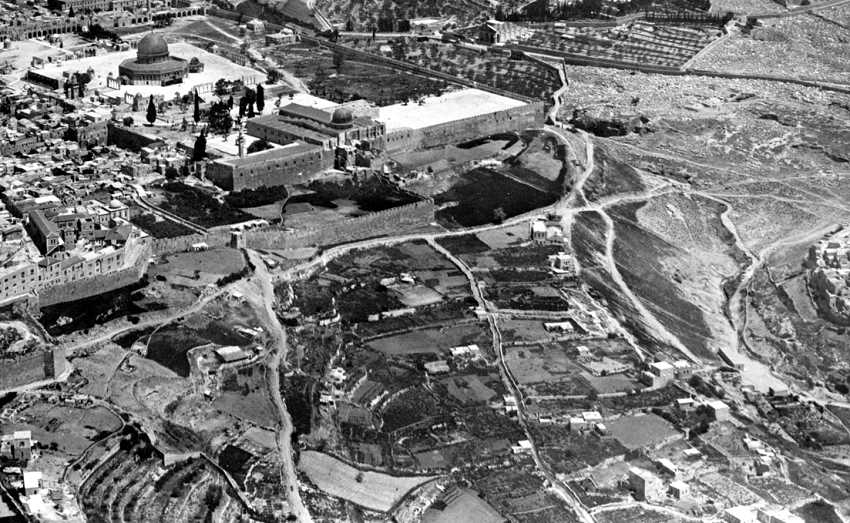
Even so, as can be seen from this aerial photograph from 1931 that zion - the city of David - is plowed like a field and the mountain of the house as the high places of a forest - scrubland and a few small trees on the temple mount.
"The mountain of the house?" The temple mount of course!
New Testament
Luke 19:41-45
"And when he was come near, he beheld the city, and wept over it,
Saying, If thou hadst known, even thou, at least in this thy day, the things which belong unto thy peace! but now they are hid from thine eyes.
For the days shall come upon thee, that thine enemies shall cast a trench about thee, and compass thee round, and keep thee in on every side,
And shall lay thee even with the ground, and thy children within thee; and they shall not leave in thee one stone upon another; because thou knewest not the time of thy visitation.
And he went into the temple, and began to cast out them that sold therein, and them that bought;"
Jesus beheld the city, wept over it and said "they shall not leave in thee one stone upon another" — clearly meaning the city — was he beholding the city of David? Does the image of Jerusalem from 1931 (above) show that?
Few realise the politics of the situation during Jesus' time, and therefore might not understand the depth of His meanings. As you can find from the Books of the Wars by Josephus, and in other places, there were warring factions within Judaism: mainly between the orthodox or strict Jews and the Hellenised Jews, and in addition the Romans competing for control amongst the confusion. Jesus obviously knew the outcome. As God, the meaning of His life and mission was to establish a new covenant - the old one lapsing on His death. This He preached in the temple, but knowing the extremism of the orthodoxy meant Him talking in parables. Basically, the orthodox had introduced far more laws than God had given them, and Jesus was rejecting their laws, and at the same time warning them of the consequences.
Rather than accepting Him as the Word of God and God in the flesh, He was rejected, and so came the time to bring an end to God's covenant with Abraham's Jewish descendants. The covenant could only be broken by the death of one of the party, and that required the death of Jesus as God in the flesh. Prior to that, however, Jesus had announced a new covenant, which He preached but the orthodox Jewish leaders refused Him. This culminated in His last visit to the temple, which is picked up in Matthew 21:23, and after telling them "Behold, your house is left unto you desolate." (Matthew 23:38) Jesus walks out of the place, leaving the the temple for the very last time - onto its esplanade and meeting with His disciples, who had heard him "Then spake Jesus to the multitude, and to his disciples,"(Matthew 23:1). "His disciples came to him for to shew him the buildings of the temple" (Matthew 24:1) probably in disbelief of what He had just said "Behold, your house is left unto you desolate." (Matthew 23:38). "And Jesus said unto them, See ye not all these things? verily I say unto you, There shall not be left here one stone upon another, that shall not be thrown down." (Matthew 24:2)
This was Jesus leaving those temple buildings on the temple mount. The context should make it obvious.
The original temple, as we should have noticed from the verses from the Old Testament was a complex place with a large number of buildings:
1 Chronicles 28:11
"Then David gave to Solomon his son the pattern of the porch, and of the houses thereof, and of the treasuries thereof, and of the upper chambers thereof, and of the inner parlours thereof, and of the place of the mercy seat,"
The second temple as we can find elsewhere, wasn't quite a match for the first, but as we'll learn, was greatly expanded by Herod (who was incidentally, a Jew) to show off his magnanimity.
The temple itself stood in a massive compound or esplanade which had been initially extended by the Hasmoneans during the Hellenistic times of the Second Temple period, and Herod increased its size further to include a large basilica known as the Royal Stoa along its southern end. The other sides had massive cloisters. The temple stood in the midst of the esplanade, where the crowds of worshippers would gather.
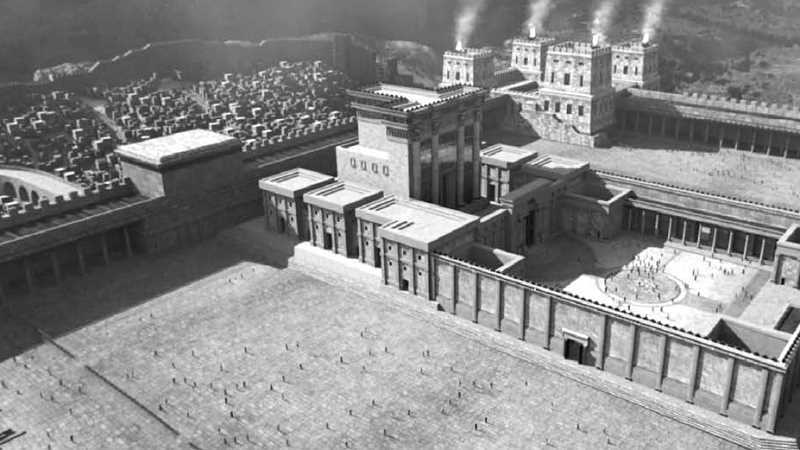
Artist's impression of Herod's completed temple mount finished some 30 years after the crucifixion of our Lord, and about 60 years after Herod's death
It's against this backdrop that we need to view Jesus in the "Olivet discourse" (Matthew 24, Mark 13, Luke 21), and each starts with Jesus on the esplanade and not on the mount of Olives. And because this is so extremely pivotal for those who deny the temple mount — calling it Antonia instead — this can be a source of heated argument.
However, if we read it in context — something incidentally preached hard by the deniers — then it's as plain as day that the destruction of the temple was prophecied during the time Jesus stood on the esplanade (the temple mount).
The Matthew 24:1-2 prophecy timeline starts back in Matthew 21:23. Jesus was in the temple all the way through to Matthew 24:1-2. When he left the temple, meeting up with His disciples on the esplanade (the temple mount) this happened:
Matthew 24:1-2
"And Jesus went out, and departed from the temple: and his disciples came to him for to shew him the buildings of the temple.
And Jesus said unto them, See ye not all these things? verily I say unto you, There shall not be left here one stone upon another, that shall not be thrown down."
Mark 13:1-2 likewise begins in Mark 11:27 and ends with these words from Mark 13:1-2
"And as he went out of the temple, one of his disciples saith unto him, Master, see what manner of stones and what buildings are here!
And Jesus answering said unto him, Seest thou these great buildings? there shall not be left one stone upon another, that shall not be thrown down."
Notice the word "here" — "There shall not be left here one stone upon another — "what manner of stones and what buildings are here!" He'd have to be there, and not a "Sabbath's distance" away on the mount of Olives.
In fact, the prophecy of the end of the world starts on the mount of Olives at verse 3 in both:
"And as he sat upon the mount of Olives, the disciples came unto him privately, saying, Tell us, when shall these things be? and what shall be the sign of thy coming, and of the end of the world?"
"And as he sat upon the mount of Olives over against the temple, Peter and James and John and Andrew asked him privately,"
What Jesus said in verses 1-2 looks more like judgement than a prophecy - a judgement based on the happenings in the temple, if taken in context.
The book of Luke handles this in a slightly different manner, starting in Luke 20:1
"And it came to pass, that on one of those days, as he taught the people in the temple, and preached the gospel, the chief priests and the scribes came upon him with the elders,"
Follow the story and the context is apparent. Whereas Matthew's and Mark's testimonies about the temple get lumped in with the "end of the world," Luke's nicely runs over the chapter, still in context, and doesn't end as neatly, but the "judgement" of the temple is in 5-6
"And as some spake of the temple, how it was adorned with goodly stones and gifts, he said,
As for these things which ye behold, the days will come, in the which there shall not be left one stone upon another, that shall not be thrown down."
When Jesus entered the temple the disciples, due to them being common men, were waiting along with the multitude (Matthew 23:1). Overhearing their master while he was preaching and arguing with those inside. The disciples would have been left to roam about the temple mount - the esplanade and its surrounding structures - the cloisters; Royal Stoa (if it had been built by then); the temple's numerous buildings as we learnt earlier in 1 Chronicles 28:11.
These were the manner of stones and buildings of the temple they would be showing to the Master as He came out. And what he said in reply to them came true in 70AD - all that they saw was thrown down by the Romans. It was utter destruction of the temple and its buildings with no remains to be found, plus much of the temple mount's walls were also thrown down.
There are plenty of photographs of what the temple mount looks like today, from which you might note that the upper walls differ greatly from the stonework near its base. And that's because various religious groups have rebuilt the outer walls over the years, but not to the former splendour.
The Romans raised a temple to Jupiter which was later demolished... by the Romans! The Jews with Rome's permission tried without success to build another temple - an earthquake and fire coming out of the ground stopped that. Then the Byzantines; the Sassanids; the Early Muslims; the Crusaders; the Mamluks and the Ottomans.
As the section on Josephus will show, the Antonia was bigged-up probably because he was writing it for his adopted family - the Flavian's - Vespasian having reached the dizzy heights of the Emperor of Rome.
The 50 cubit rock on which Antonia was built was found by the PEF, surveyed and drawn, and through considerable research, and thanks to somebody from BYU archiving it online, is available to view on this site.
The Antonia was first built by John Hyrcanus - a Hasmonean leader and Jewish high priest of the 2nd century BC - as a barracks to guard, and vestry for, the temple. Herod (a distant relation of John Hyrcanus) had made it more splendid as it stood at the north-west corner of the temple, and dedicated it to his friend, Marcus Antonius.
In most Bibles in Acts 21 and 22, it is called a castle, or a barracks, a stronghold or even a headquarters. A few call it a fort or a fortress.
Acts 21:31-37
"And as they went about to kill him, tidings came unto the chief captain of the band, that all Jerusalem was in an uproar.
Who immediately took soldiers and centurions, and ran down unto them: and when they saw the chief captain and the soldiers, they left beating of Paul.
Then the chief captain came near, and took him, and commanded him to be bound with two chains; and demanded who he was, and what he had done.
And some cried one thing, some another, among the multitude: and when he could not know the certainty for the tumult, he commanded him to be carried into the castle.
And when he came upon the stairs, so it was, that he was borne of the soldiers for the violence of the people.
For the multitude of the people followed after, crying, Away with him.
And as Paul was to be led into the castle, he said unto the chief captain, May I speak unto thee? Who said, Canst thou speak Greek?"
Acts 22:23-24
"And as they cried out, and cast off their clothes, and threw dust into the air,
The chief captain commanded him to be brought into the castle, and bade that he should be examined by scourging; that he might know wherefore they cried so against him."
Hereby ends the evidence in the Bible.
back to top